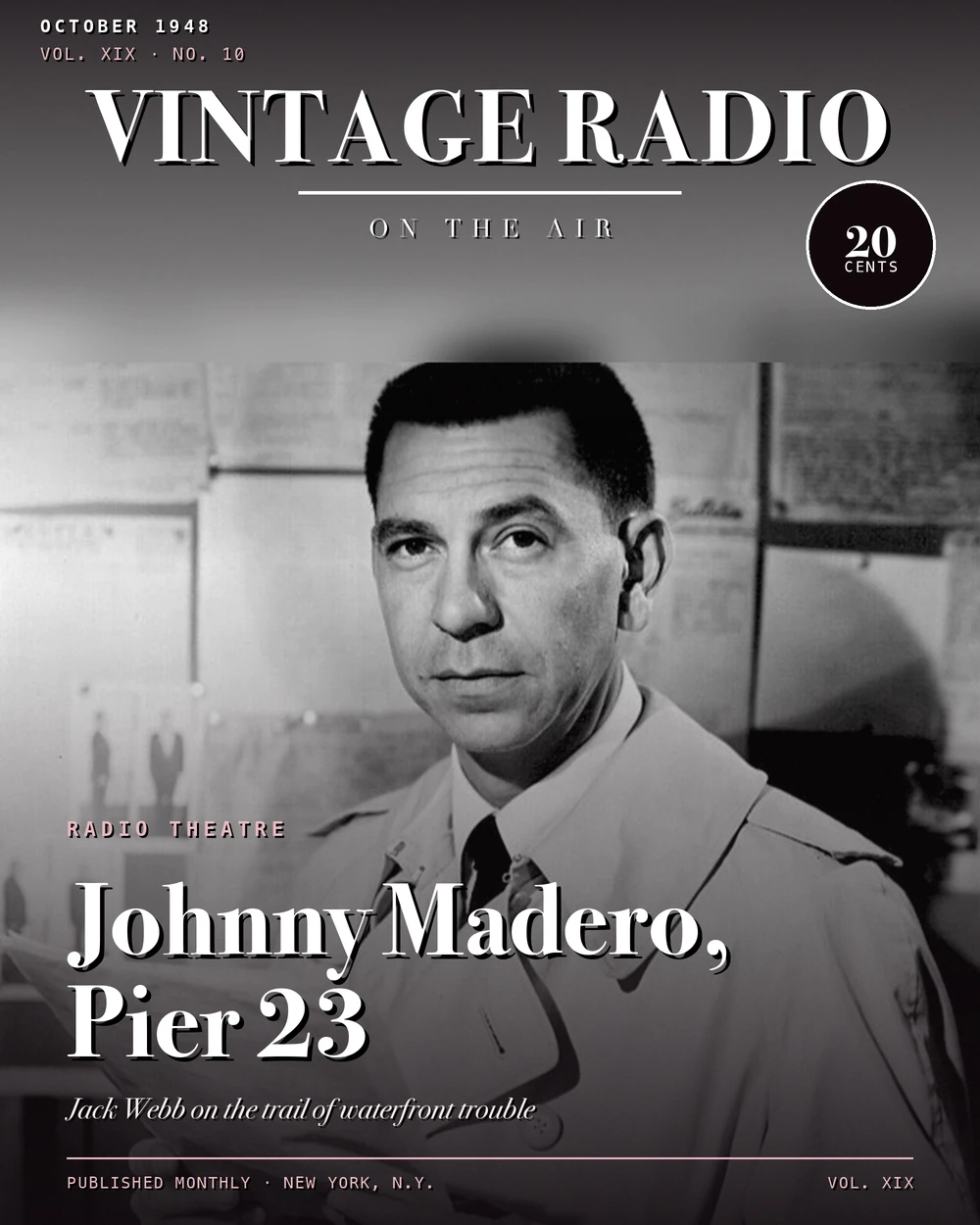
Johnny Madero, Pier 23
How It Got on the Air
The story behind Johnny Madero, Pier 23 begins with a dispute, a cross-country move, and a title character who couldn't legally use his own name. Jack Webb had been working in San Francisco playing Pat Novak, a waterfront troubleshooter created by writer Richard Breen with what one contemporary description nailed as a "bile-dipped pen" — sharp, sardonic, and built around one-liners strung together just tightly enough to resemble a plot. Pat Novak made Webb a national radio personality. Then a falling-out between Breen and KGO station management blew everything apart.
Webb and Breen had been roommates in San Francisco, and they left together for Hollywood in 1947. The problem was that Pat Novak stayed behind. The show kept running in San Francisco with a new actor, Ben Morris, in the title role and a new writer, Gil Doud, producing a noticeably different sound. The character and the format were still in use — which meant Webb and Breen couldn't just pick up where they'd left off. So they created a new character. Johnny Madero was a San Francisco waterfront troubleshooter who rented boats and did, in the show's words, "anything else you can blame on the environment." His office was at Pier 23. Pat Novak had worked out of Pier 19. The pier number was different. The character was not.
ABC, which had been airing Pat Novak, noticed the resemblance immediately and sued Mutual for plagiarism. In the debut episode, Madero's regular adviser had been a world-wise drunk named Dipso — a direct echo of Pat Novak's mentor, a character named Jocko Madigan. To placate ABC, Mutual dropped Dipso and replaced him with a waterfront priest, Father Leahy, played by Gale Gordon. The swap solved the legal problem without much changing the dynamic: Father Leahy was prone to lengthy philosophical ruminations in a laconic, wandering style that Madero would simply talk over, which was more or less what Novak had done with the drunk. The stories got a collar on the adviser. The attitude remained identical.
The Sound of the Show
Johnny Madero was, by its own implicit admission, not about plot. The stories were described even at the time as almost devoid of sensible plots — they existed mainly to deliver one-liners. Madero had the same chip-on-his-shoulder energy as Pat Novak, the same snappy comebacks, the same staccato rhythm in the dialogue. This was Webb's first coast-to-coast excursion into that format, broadcasting from Los Angeles rather than San Francisco, and the Mutual network carried it nationally on Thursday evenings at eight.
The show's best moments, by most accounts, were the exchanges between Madero and the menacing police inspector Warchek, played by William Conrad. In the Pat Novak years, that antagonist role had belonged to Raymond Burr, playing an inspector named Hellman. Here the role went to Conrad, and the angry wisecracks the two characters traded back and forth gave the series its sharpest edges. Conrad was already doing ten to fifteen radio programs a week at his peak, and his voice — authoritative, heavy with menace — made Warchek a credible obstacle even when the plot wasn't giving him much to work with. The week-to-week formula had Madero and Father Leahy using double-dealing to stay ahead of Warchek while they pursued whoever actually needed pursuing. Whether they caught the right person was secondary to whether the lines landed.
Music was composed by Harry Zimmerman, Nat Wolff directed, and the writing team beyond Breen included Herb Margolis and Lou Markheim. Tony LoFrano announced. The supporting cast on individual episodes included Betty Lou Gerson, Elaine Burke, Bob Holden, Herb Butterfield, and Herb Rawlinson, among others. Actor John Garfield guest-starred in at least one surviving episode, appearing as the man who hires Madero. Francis X. Bushman also appeared in at least one episode.
The People Behind It
Jack Webb was twenty-six when Johnny Madero aired, still a few years away from Dragnet and the career that would define him. He and Breen had developed their working relationship entirely in San Francisco, and the move to Hollywood was the beginning of a new phase for both of them. Webb credited Breen with encouraging the underplayed delivery style that would run through Pat Novak, Johnny Madero, and eventually Joe Friday — the flat, clipped reading that sounded like it was barely trying and carried enormous conviction because of it.
Breen was born in Chicago, attended Fordham University on a scholarship, earned an M.A. in philosophy, and served in the Navy in the Pacific during World War II before landing in radio. After Johnny Madero, he moved fully into Hollywood screenwriting and won the Academy Award for Best Screenplay for the 1953 film Titanic. He received additional Oscar nominations for A Foreign Affair and Captain Newman, M.D., and served as the first president of the Writers Guild of America, West from 1954 to 1955.
Gale Gordon, born Charles Thomas Aldrich Jr., had been in radio since 1926 and by 1933 was reportedly the highest-paid radio actor in Hollywood. He was the first actor to play Flash Gordon, in the 1935 serial The Amazing Interplanetary Adventures of Flash Gordon. By the time Johnny Madero aired, he was doing double and sometimes triple duty across multiple network programs simultaneously. Father Leahy was an unusual part for him — Gordon's portfolio ran heavily toward comedy, and the philosophically wandering, quietly devious priest was a departure. He had just come off a dramatic run as bachelor-sleuth Gregory Hood on The Casebook of Gregory Hood on the same Mutual network, so the dramatic register wasn't new to him, but the character type was. Gordon later received a star on the Hollywood Walk of Fame in 1960 in the radio category and was posthumously inducted into the Radio Hall of Fame in 1999.
William Conrad — born John William Cann Jr. in Louisville, Kentucky — started as an announcer, writer, and director at Los Angeles radio station KMPC in the late 1930s, then served as a fighter pilot in World War II, reaching the rank of captain and producing programs for the Armed Forces Radio Service. He estimated he appeared in more than 7,500 radio roles across his career. He is best known in radio history for originating the role of U.S. Marshal Matt Dillon on CBS's Gunsmoke, which he played across 480 episodes from 1952 to 1961 before being passed over for the television adaptation because his physique didn't match the image of the character. He was posthumously elected to the National Radio Hall of Fame in 1997.
What Came Before and After
Johnny Madero occupied a specific slot in Jack Webb's pre-Dragnet radio career — the second of three detective vehicles he led before Dragnet launched in 1949. Pat Novak came first, then Madero, then Jeff Regan, Investigator on CBS in 1948 and 1949. Jeff Regan marked a departure from the staccato-simile style; Regan was a fully licensed private investigator affiliated with an agency, and the show had a different texture entirely. Madero was still clearly in the Novak mold.
After Johnny Madero was cancelled, Webb and Breen reconciled with ABC and returned to Pat Novak for Hire for a second run in 1949 — most of the Pat Novak episodes that survive date from that second Webb tenure. Meanwhile, Webb's film work was getting underway while Madero was still on the air. He had a featured role in the 1948 film He Walked by Night, and it was on that film's set that an LAPD technical advisor's observations about police realism planted the idea that would become Dragnet.
The waterfront troubleshooter concept didn't disappear when Madero left the air. Lippert Productions picked it up in 1951 and produced three B-mystery films — Pier 23, Roaring City, and Danger Zone — starring Hugh Beaumont as a San Francisco waterfront boat-shop operator named Dennis O'Brien who moonlighted as a freelance troubleshooter. The setup was virtually identical to both Novak and Madero: San Francisco waterfront, a hostile police inspector, a waterfront priest as recurring character. One reviewer noted that the Pier 23 scripts appeared to have been taken almost directly from Pat Novak radio scripts with the names changed, and that the dialogue sounded "like an old radio program." The three Lippert films were each structured as two linked thirty-minute segments so they could be split for television syndication.
How It Ended
Johnny Madero, Pier 23 ran sixteen episodes between April 24 and September 4, 1947, airing Thursdays at eight on Mutual via the Don Lee affiliate chain. It was a summer replacement series and was not renewed for the fall season. Two episodes are known to survive: "Find Pete Sutro," which aired June 19, 1947, and "Fatal Auction," which aired June 26, 1947. A third known episode title is "The Man Who Chased Himself." The series was created by Webb, Breen, and William P. Rousseau, who was born in 1915 and died in 1972.
As a radio run, sixteen episodes over five months is slight. But Johnny Madero was doing what it needed to do — keeping Webb and Breen working, in front of a national audience, refining the style that would eventually produce one of the most successful police dramas in broadcast history. The show was too thin on plot and too short-lived to be a landmark on its own terms. What it represents is a bridge: the moment Webb and Breen took their San Francisco sound coast-to-coast, even if the vehicle that carried it wasn't built to last.